Home service lead conversion rates often suffer because businesses fail to respond instantly to inquiries or miss after-hours calls. AI technology plugs these leaks by automating immediate follow-ups and providing 24/7 lead engagement; this ensures that no potential customer is ignored while human staff are busy or offline.
Every home service owner knows the frustration of watching a hard-earned lead slip through the cracks because a technician was on a job or the office phone rang while the dispatcher was occupied. In high-demand markets, these missed connections are more than just minor inconveniences; they represent a systemic leak that typically costs businesses up to forty percent of their potential revenue. If your response time exceeds five minutes, you are likely handing your customer directly to a competitor who answers faster. This guide explores how Turks Pulse AI leverages automated operations to bridge the speed to lead gap. You will learn how AI missed call text-backs, automated qualification workflows, and strategic CRM nurturing can transform your conversion rates. We will demonstrate how to stop wasting your marketing budget and start turning every inquiry into a confirmed booking through sophisticated AI integration.
The 40 Percent Leak: Why Most Home Service Leads Never Book
Statistics indicate that approximately 40 percent of leads in the home service industry never result in a booked appointment. This is rarely a failure of the marketing strategy or lead quality; rather, it is a structural failure of the intake process. Most local businesses operate with what we call a leaky bucket in their marketing spend. They invest heavily in local SEO and high-intent PPC campaigns to fill the bucket with leads, yet they lose their return on investment through holes at the very bottom of the funnel.
For plumbers, HVAC technicians, and electricians, these friction points are often unavoidable consequences of being in the field. A lead may call while a technician is under a sink, on a roof, or navigating a crawl space. When the phone rings and goes unanswered, the lead does not wait. In the modern market, a voicemail is often viewed as a dead end. Homeowners in need of urgent repairs will simply move to the next name on the search results. This specific moment of silence is where home service lead conversion fails for most companies.
Solving this requires more than just more aggressive marketing; it requires an integrated AI operations platform to manage the intake. Without automated systems like AI missed call text-backs to capture attention immediately, that 40 percent of potential revenue disappears. The goal is to ensure that being busy on a job site does not result in a missed business opportunity.
The Speed to Lead Gap: Why Response Time is Everything in Miami
In the high-stakes Miami market, timing dictates your close rate more than your price point. The industry standard 5-minute rule for home service lead conversion is not merely a suggestion; it is a statistical boundary. Data indicates that the probability of connecting with and qualifying a lead drops by 10x if the response occurs after the five-minute mark. By thirty minutes, the lead has often moved on entirely.
The competitive landscape in South Florida amplifies this pressure. When an AC unit fails in the August heat or a pipe bursts, homeowners rarely leave a single message and wait. They typically call three to five businesses in rapid succession. The first provider to respond, whether through a voice call or an immediate text, usually wins the job because they provide the quickest path to a solution.
Maintaining this level of responsiveness manually is physically impossible for a growing team. Technicians are focused on the task at hand, and office staff cannot be available 24/7 to catch every digital inquiry. Without an AI operations platform, these high-intent leads slip through the cracks during commutes, lunch breaks, or after-hours. Utilizing SMS follow-ups and AI missed call text-backs ensures that your business is always the first to engage, effectively removing the window of opportunity for your competitors.
The Hidden Cost of Missed Calls and Voicemails
The silence following a missed call is the most expensive sound in your business. While service providers often view an unanswered phone as a minor delay, the modern homeowner views it as a closed door. In 2024, leaving a voicemail feels like an outdated friction point that most consumers bypass in favor of instant gratification. When a potential customer in Miami hits your greeting, they rarely wait for the beep; they simply hang up and click the next high-ranking result on Google.
To understand the impact on your home service lead conversion, consider the math of a typical operation. If your average job value is $500 and you miss just five calls per week, you are effectively forfeiting $2,500 in weekly revenue. Over the course of a month, that totals $10,000 in lost opportunities. This isn't just theoretical; it is a direct drain on your marketing ROI. Relying on an office manager or technician to return these calls hours later ignores the reality that the lead has likely already booked with a competitor. Integrating AI missed call text-backs through a dedicated AI operations platform transforms these silent hang-ups into active text conversations, capturing the revenue that would otherwise vanish while you are on a job site.
How AI Missed Call Text-Backs Save the Sale
The transition from a missed call to a lost opportunity happens in the three seconds it takes for a lead to tap the next phone number on their screen. AI missed call text-backs intervene at this precise moment of friction. The technical workflow begins when an incoming call to your business line goes unanswered or hits a busy signal. Instead of routing the lead to a stagnant voicemail box, the AI operations platform identifies the caller's mobile number and triggers an immediate, personalized SMS.
By sending a message such as, "Hi, this is [Your Company Name]. Sorry we missed your call! How can we help you today?", you provide an instant acknowledgment that halts the lead’s search. In the psychology of home service lead conversion, this text functions as a digital holding pattern. Most homeowners keep calling down a list because they need a confirmation that someone is available to help. Once they receive a text, they feel engaged and are significantly less likely to dial the next competitor. The friction of waiting for a callback is replaced by the ease of a text conversation.
This automation serves as a bridge rather than a barrier. It is not designed to replace the human touch of a technician or office manager, but to facilitate it. By initiating the conversation via text, you allow the lead to provide details about their plumbing emergency or HVAC repair immediately. This creates a logged, actionable conversation in your CRM that your team can step into as soon as they are off the current job, turning a potential hang-up into a scheduled appointment.
Qualifying Leads with AI Automation and CRM Workflows
Capturing a lead via a text-back is an essential first step, but not every inquiry deserves an immediate site visit or a thirty-minute phone consultation. High-volume periods often bring in a mix of high-intent emergency jobs and low-intent price shoppers. Without a filtering mechanism, your team can become overwhelmed by leads that do not fit your service area or budget requirements, causing your actual home service lead conversion rates to stagnate despite an increase in raw lead volume.
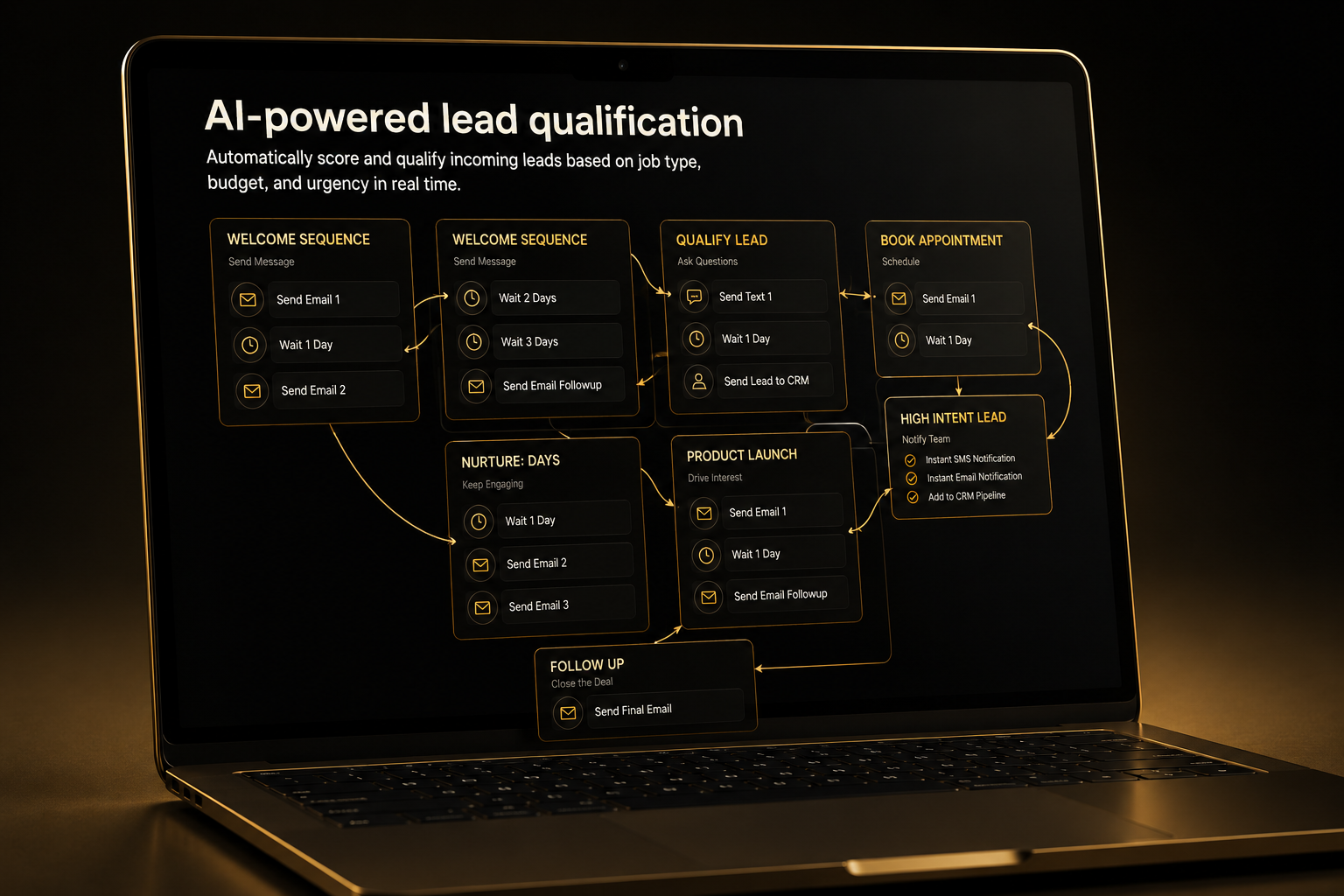
Our AI operations platform addresses this by deploying automated qualification sequences. Once the initial contact is established, the system sends targeted SMS follow-ups or emails to gather critical data points. The AI asks specific, logic-based questions: "What is the zip code of the property?", "Is this an emergency repair or a request for a quote?", or "Can you provide a brief description of the issue?". These responses allow the system to categorize the lead before a human ever touches the file, ensuring that your limited time is allocated to the most profitable opportunities.
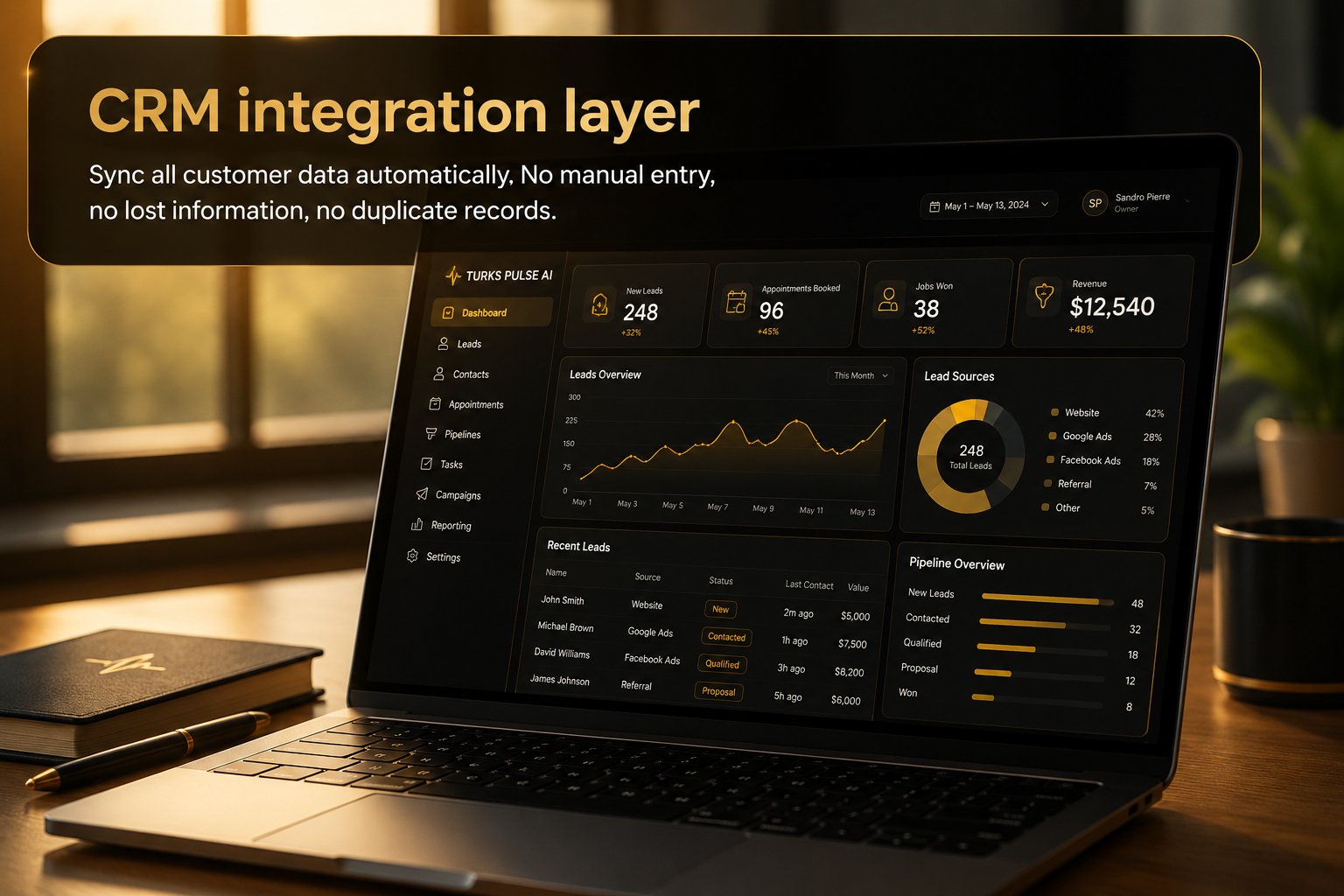
This automated intake ensures that technicians and business owners prioritize high-value projects while the system handles the preliminary legwork. All gathered information syncs directly into your central CRM to prevent data silos where information is trapped in a technician's personal text thread or an unmonitored inbox. By automating the data entry and qualification phase, the full context of the lead's needs is visible to the entire team, allowing for a more informed and professional hand-off when it is time to finalize the booking.
Long Term Nurture: Turning 'Not Now' into 'Next Month'
Qualified leads do not always translate into immediate revenue. Many homeowners are gathering multiple quotes, waiting for a specific budget cycle, or simply deferring a non-emergency project. Without automated systems, these prospects typically vanish because manual follow-up is the first task abandoned when the office gets busy. An AI operations platform solves this by maintaining a consistent presence through SMS follow-ups and email sequences that run in the background without requiring a single minute of your staff's time.
Consider a high-ticket roofing or landscaping quote that remains unbooked. A strategic 30-day nurture sequence might look like this: 1. Day 2: A personalized text asking if the homeowner has questions regarding the specific line items in their estimate. 2. Day 7: An automated email showcasing a gallery of similar local projects to build social proof. 3. Day 15: A value-driven SMS providing a tip on South Florida storm preparation or drainage maintenance. 4. Day 30: A final check-in to see if the project is still on the horizon or if the quote needs a formal update.
This persistent, low-pressure engagement ensures your business remains the primary choice when the homeowner is finally ready to move forward. By automating the nurture phase, you maximize your total home service lead conversion by capturing the long-tail revenue that normally falls through the cracks weeks after the initial inquiry.
Implementing AI Operations in Your Miami Business
Transitioning to an AI operations platform does not mean stripping the personality from your Miami business. In a city where personal reputation and word-of-mouth drive high-quality jobs, responsiveness is the ultimate form of customer service. AI scales your ability to be prompt without sacrificing the local touch.
To begin, perform a manual audit of your current funnel. Track every inbound call for one week and identify exactly how many times the phone rang more than four times or went to voicemail. This data reveals the exact location of the leak in your home service lead conversion process.
Start your implementation with AI missed call text-backs. This provides the immediate engagement South Florida homeowners expect when their AC fails or a pipe bursts. Once your intake is secured, integrate automated SMS follow-ups to handle qualification. This phased roadmap ensures your team is not overwhelmed while your revenue grows.